In recent years, there has been a notable surge in interest focused on refining autonomous systems, particularly in advancing robot navigation through the strategic utilization of sensing data. However, this heightened attention has also raised significant privacy concerns. To effectively address these challenges while capitalizing on the benefits of sensing-based robot navigation, this paper introduces a novel concept of Radio Frequency (RF) map creation derived from ray-tracing within a digital twin of an unstructured environment. We present a systematic pipeline for utilizing NVIDIA’s Sionna Ray-Tracing tool to generate propagation models of the digital twin generated in Blender by taking inputs from the real world. Through the integration of the RF map, we propose a reinforcement learning based approach to facilitate robot navigation. This integration process enables the formulation of RF propagation models tailored for mobile robots operating within indoor environments. The validation process shows the feasibility of the proposed algorithm in an indoor lab setup with the robot navigating through the various obstacles avoiding any collision. Our work represents a significant advancement towards the practical implementation of robot navigation by harnessing RF propagation data generated through ray-tracing. Through our proposed framework, we contribute to the development of a robust and privacy-preserving approach for robot navigation in autonomous environments.
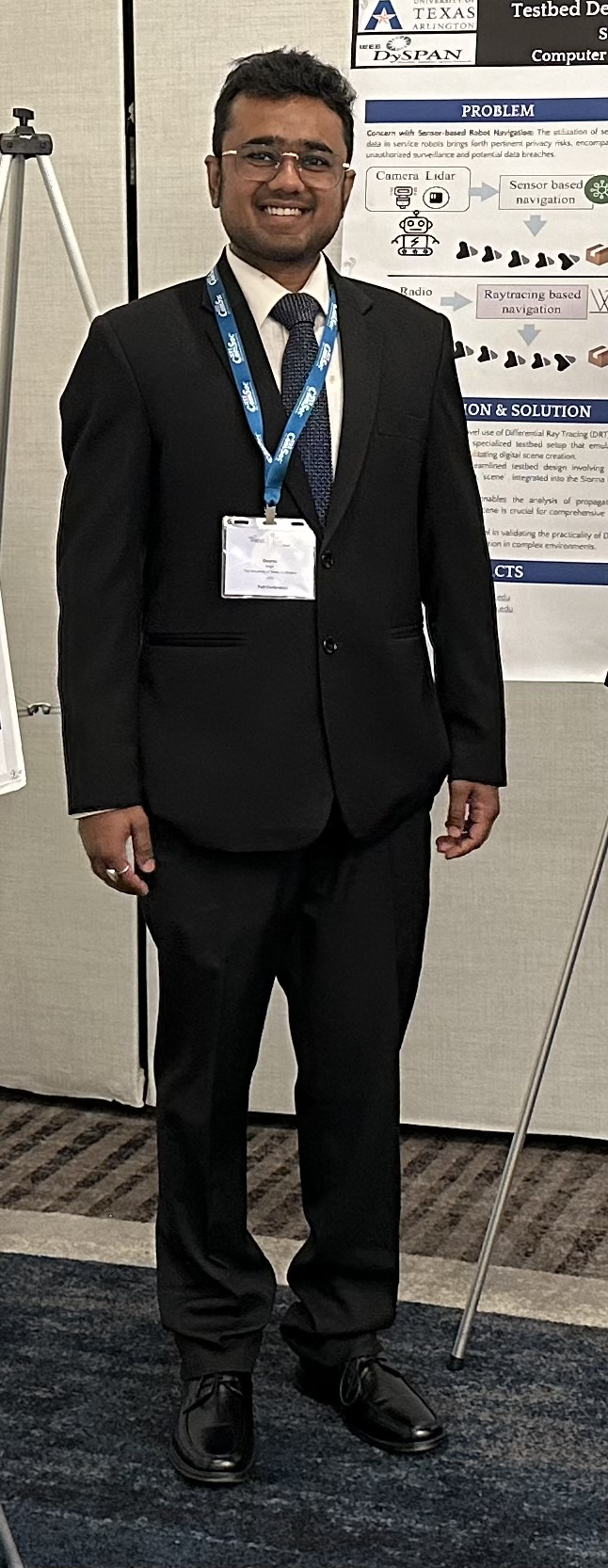
Gaurav Singh
PhD Student in Computer Science
Department of Computer Science and Engineering
The University of Texas at Arlington
- Arlington, Texas, USA
- University of Texas at Arlington
- Google Scholar
- ORCID
- ResearchGate
- Github